




Immediate-loading dental implants: recover your smile in a single day
Losing a tooth is never just an aesthetic matter. It changes how you chew, how you smile and, in many cases, the confidence with which you speak or relate to others.
For years, the process of replacing a lost tooth required patience. The implant was placed and then patients had to wait several months before the final crown could be fitted. Today, thanks to advances in digital planning and surgical techniques, there is another possibility: immediate-loading dental implants.
In simple terms, it means you can have the implant placed and leave the clinic the same day with a fixed provisional tooth.
But as is almost always the case in dentistry, the short answer needs context.
What does “immediate loading” actually mean?
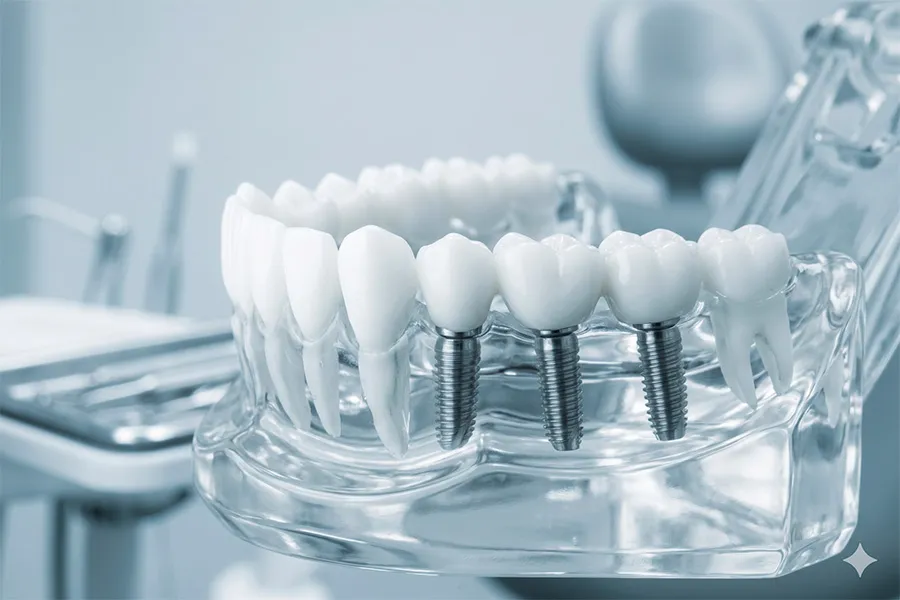
A dental implant is a small titanium piece that acts as an artificial root. It is inserted into the bone and, over time, integrates through a natural process called osseointegration.
In the traditional protocol, after placing the implant it is left to rest for several months to ensure that integration before placing the final tooth.
Immediate loading changes the timing, but not the biology. The implant is placed in the same way, with the same precision, but instead of waiting months to see a tooth in the mouth, a fixed provisional crown is placed the same day.
It is important to understand something: the implant still needs time to integrate. What changes is that during that process the patient is not left without a tooth.
It is not a “fast” technique, it is a well-planned one
Immediate loading is often associated with speed, even with marketing. But the reality is that, if anything characterises this treatment, it is prior planning.
Before deciding whether a patient can benefit from this technique, we carry out a complete study. The analysis of the bone, the ideal position of the implant and the state of the gums are decisive.
In fact, when there is active periodontal disease, we do not recommend this type of treatment until it is stabilised. Si te interesa entender cómo afecta la periodontitis a la pérdida dental, puedes leer nuestro artículo sobre periodontal disease, where we explain in depth how it influences the stability of teeth… and of implants too.
Because an implant cannot settle in an inflamed environment.
Can everyone have implants in 24 hours?
The honest answer is no.
For immediate loading to be safe, we need the implant to be firmly anchored from the very first moment. We call this primary stability. If the bone is insufficient or too soft, forcing the protocol would not be prudent.
Bite pattern, the habit of clenching at night and the general state of the mouth also play a role. Pacientes con bruxismo severo, por ejemplo, pueden necesitar un enfoque diferente o protección adicional. In our article on bruxism we explain how this condition affects implants and prostheses.
Every mouth is different. And that is the key point.
What does the patient feel on the day of surgery?
The surgery is performed under local anaesthetic. The procedure, in experienced hands, is usually simpler than patients imagine.
After placing the implant, a fixed provisional prosthesis is fitted. It is not the final tooth, but it fulfils two essential functions: restoring aesthetics and protecting the implant during its integration.
The patient leaves the clinic with a fixed tooth. That feeling has a significant emotional impact, especially when we are talking about visible teeth when smiling.
In the following days, mild inflammation or manageable discomfort may appear, controlled with medication. Most patients resume their usual routine quickly.
The part almost no one explains: the commitment afterwards
Immediate loading does not end on the day of surgery. In fact, it begins there.
During the first weeks we ask the patient to avoid chewing hard foods in the treated area. The provisional prosthesis is designed not to overload the implant while the bone integrates it.
Hygiene is also decisive. An implant can fail not because of the surgery, but due to plaque build-up and inflammation of the surrounding tissues. If you want to review how to maintain proper hygiene after a dental treatment, we have a specific article about it on our blog.
A complete diagnosis, free of charge
Find out the real condition of your oral health and exactly what treatment you need. A full dental check-up with advanced technology — no commitment, completely free.
Check-up value: €180 · No commitment · No small print
- ✓Panoramic X-ray
- ✓Cephalometric X-ray
- ✓Intraoral scan with 3D treatment simulation
- ✓Extraoral and intraoral photographs
- ✓Personalised diagnosis and treatment plan
In modern dentistry, success is always shared between professional and patient.
Is it as reliable as the traditional method?
Yes, when it is properly indicated.
Current scientific evidence shows that the success rates of immediate-loading implants are comparable to those of conventional protocols, provided the appropriate clinical criteria are respected.
The difference is not in the duration of the implant, but in the correct case selection.
That is why we insist so much on prior diagnosis. Not every treatment should be fast. Some should be prudent.
What if there is not enough bone?
Sometimes prolonged tooth loss causes bone resorption. When that happens, it may be necessary to regenerate bone before placing the implant or to use complementary techniques.
In these cases, forcing immediate loading is not recommended. Initial stability is essential. If we do not have it, we prefer to follow a more conservative protocol.
Responsible dentistry does not compete on speed. It competes on long-term results.
Beyond the technique: the real impact
What strikes us most in clinic is not the technical aspect of the procedure, but the change in the patient’s expression.
When someone loses a front tooth, they often stop smiling naturally. They cover their mouth when speaking. They avoid photos.
Leaving the same day with a fixed tooth transforms that experience.
It is not just a functional matter. It is psychological.
And that is where immediate loading adds differential value.
How long can these implants last?
A well-integrated and well-maintained implant can last decades. But there are factors that affect this: daily care, regular check-ups, tobacco control and the state of the gums.
An implant is not a “spare part” you fit and forget. It is part of your mouth and needs professional maintenance.
In our check-ups we not only confirm everything is stable, we also prevent problems before they appear.
So, is it the best option?
It depends on the case.
For some patients it is the ideal solution. For others, the traditional protocol offers greater safety.
What matters is not promising “teeth in a day”. What matters is offering a personalised treatment, based on diagnosis and clinical experience.
At Clínica Dental Oris we believe in technology, but also in judgement. Biology still sets the timing, even as technique advances.
If you are considering a dental implant and want to know whether immediate loading is right for you, the first step is a complete assessment.
Because recovering a tooth in 24 hours is possible.
But doing it well is what really matters.